爱情魔发师
Exclusive: China's maritime court settles Strait of Hormuz vessel collision dispute as foreign shipowners turn to Chinese law_我的网站

一 | AI摘要
厦门农商银行总部大厦外立面全面亮相,154米高楼运用BIM技术精准管控3.6万平方米复杂幕墙安装,智慧工地系统助力年底竣工目标稳步推进。
厦门农商银行总部大厦位于两岸金融中心片区。(中建三局 供图)
远望两岸金融中心片区,一栋建筑的轮廓由下至上逐渐收窄,线条流畅向上伸展。

二 |
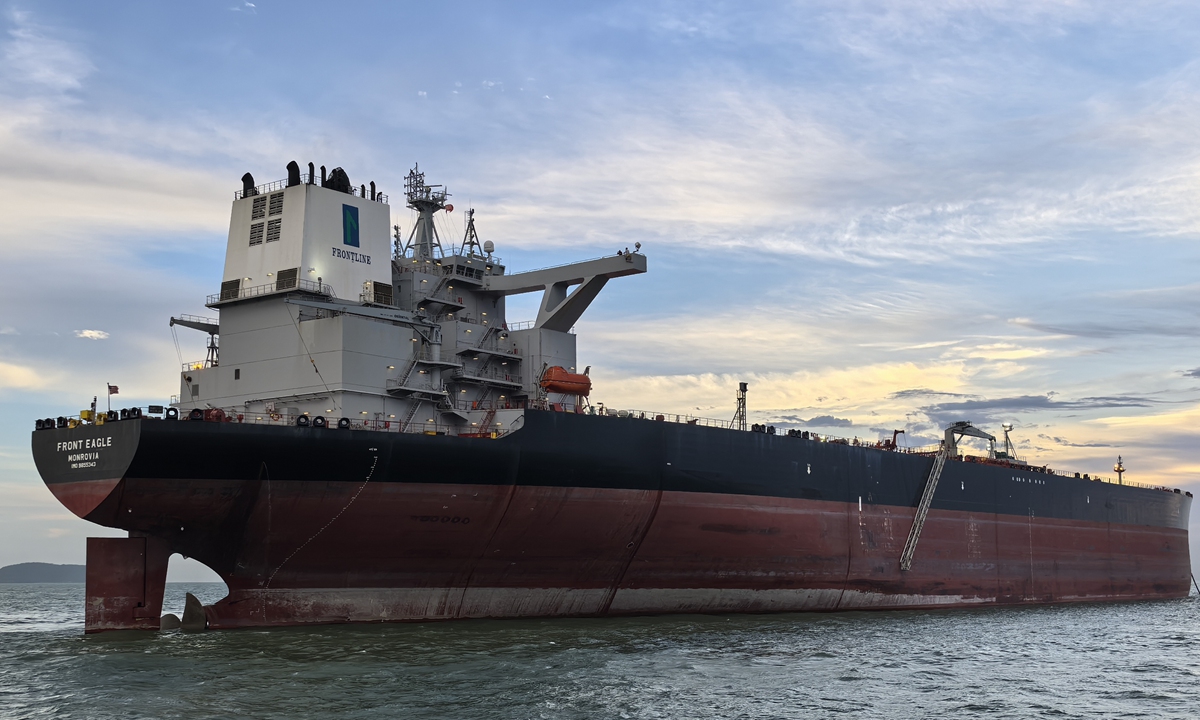
Liberia-flagged vessel Front Eagle Photo: Courtesy of China's Supreme People's Court Guangzhou Maritime Court recently successfully mediated a 180 million yuan ($25 million) dispute arising from a collision between two oil tankers in waters near the Strait of Hormuz, with both parties agreeing to apply Chinese law and submit their dispute to the Chinese court, the Global Times learned from the court on Sunday.
In 2025, two crude oil tankers collided at the eastern entrance to the Strait of Hormuz, 24 nautical miles off Fujairah, United Arab Emirates, media reported.
Owned by oil tanker operator Frontline, the Liberia-flagged vessel
Front Eagle collided with the Antigua and Barbuda-flagged vessel
Adalynn on the morning of June 17, 2025.
The
Adalynn was damaged in the fire. While the
Front Eagle was undergoing repairs in Shenzhen, South China's Guangdong Province, Global Shipping Holding Ltd., which owns the Adalynn, applied to Guangzhou Maritime Court for its arrest. Frontline provided a cash security of 203 million yuan to release the arrest and applied to establish a limitation fund for maritime claims.
The court approved the application and allowed Frontline to establish the limitation fund, setting the amount of the fund at 168 million yuan.
Guangzhou Maritime Court held four pretrial conferences on October 11, 2025, January 12, May 6 and July 13, 2026 to complete preparations for evidence examination, technical investigations and reported the relevant pretrial arrangements to the provincial high court, the Global Times learned from the court.
The court held a public hearing for the case on July 14, 2026.
No government agency had conducted an investigation into the collision, and no official findings were issued after the accident. Taking into account the unique burden-of-proof challenges in maritime collision disputes, Guangzhou Maritime Court took measures to preserve key evidence when handling the vessel arrest, including navigation logs, AIS data, voyage data recorder (VDR) records and CCTV footage, the court told the Global Times in a statement on Sunday.
Under a process that involves exchanging evidence inventories, sealing materials simultaneously and jointly reviewing them after evidence submissions, the court helped ensure the authenticity of critical records and laid the groundwork for determining the facts of the case.
As the two sides and their respective maritime experts reached sharply different conclusions over liability, the court introduced a maritime technical investigator mechanism, with the consent of both parties, allowing technical experts to participate throughout the proceedings. Drawing on the preserved evidence, investigators reconstructed the collision, assessed the vessels' encounter situation and clarified the parties' respective responsibilities.
Following the hearing, the court facilitated mediation, and the two parties reached a settlement agreement on July 27, 2026. On July 31, the court organized the distribution of the maritime liability limitation fund among creditors involved in the foreign vessel collision dispute and related charter-party disputes.
Representatives of the
Adalynn traveled from overseas to the court to present a letter of appreciation and a commemorative banner in recognition of the court's efforts, according to the court statement.
After the Guangzhou Maritime Court accepted the case, both parties agreed to apply Chinese law to establish a maritime liability limitation fund and resolve their substantive dispute, breaking away from the long-standing reliance of international shipping disputes on European and US courts and legal systems.
Choice of justice Bilov Viacheslav, a representative of Global Shipping Holding Ltd., told the Global Times that the main reason they chose a Chinese court to mediate the case is that "we want absolutely fair, unbiased approach to this issue. Because nowadays in this world, there are some countries which believe that they are authorized to give instruction to all others, which definitely is having influence on the decisions of the judge on the approach to the case."
Viacheslav gave the Chinese court's handling of the case a five-star rating, saying he had expected the dispute to take at least three years to resolve, but the Chinese court settled it within just one year. He also praised the judges and lawyers for their commitment to advancing the case throughout the proceedings.
"The judges and lawyers worked to advance the case with the same level of commitment as I did, even though the case directly concerned my own interests. This left a deep impression on me about litigation in China," Viacheslav said.
The case involved two foreign parties and a collision that occurred near the Strait of Hormuz, with no direct connection to China or Guangzhou Maritime Court initially. The fact that the parties chose to seek vessel arrest in China and agreed to apply Chinese law demonstrates the credibility and appeal of China's maritime judicial system, Wu Guining, vice president of the Guangzhou Maritime Court, who served as the presiding judge of the case, told the Global Times.
The court also introduced a maritime technical investigator mechanism in the case, an innovation aimed at addressing complex technical issues arising from vessel collision accidents, Wu said, noting that through technical investigations, the court was able to establish the facts of the case more efficiently, highlighting the integration of professional maritime investigation capabilities with China's specialized maritime adjudication system.
The case demonstrates China's ability to handle major, complex and cross-border maritime disputes with professional expertise, Wu said.
The handling of the collision between the two vessels is just one example of how Chinese courts have been dealing with a growing number of foreign-related maritime cases in recent years.
The Global Times learned from China's Supreme People's Court (SPC) in October last year that over the past 40 years, Chinese courts have handled a total of 88,000 foreign-related maritime cases involving parties from 146 countries and regions.
At a lecture held by the SPC on Friday, Shen Hongyu, director of the Fourth Civil Division of the SPC, told the Global Times that in recent years, Chinese courts have become more influential in participating in and promoting global ocean governance reform. Maritime justice serves as an important instrument for practicing the vision of a maritime community with a shared future and for advancing the reform of the global ocean governance system.
。走进施工现场细看,外立面幕墙错落排布,拼接出层层叠叠的纹理,阳光从不同角度照射,层次分明。 这栋建筑是厦门农商银行总部大厦。近日,记者从承建方中建三局获悉,目前,154米高的大厦外立面已全面亮相,室内精装修完成四成,室外景观完成七成,向着今年年底竣工备案的目标稳步推进。 中建三局厦门农商银行总部大厦项目部技术总监杨闯打开电脑里的BIM(建筑信息模型),五颜六色、密密麻麻的幕墙板块在屏幕上排开,构成整栋建筑的整体造型。

三 | 当杨闯点击任意一个板块,尺寸、造型、安装位置等信息立刻弹出。

四 | 他说:“从生产到安装,每一块玻璃、每一根型材都有自己的‘身份证’,在模型里全部对得上。

五 | ”
据介绍,该项目总共安装3.6万平方米的玻璃幕墙,包括10种不同的幕墙系统,其中,塔楼东侧双曲面造型最为复杂。此外,作为省、市级智能建造试点项目,工地现场布设了智慧监测系统,相当于给施工过程装上“眼睛”和“耳朵”,安全、扬尘、噪声都能实时掌控。(厦门日报记者 蔡绵绵 通讯员 周新 欧阳育军)。
Current article:http://4pfs.shuicengchongmingnouhuawang.bond/list_9fktpo/0scg.html
Published on:09:09:33